
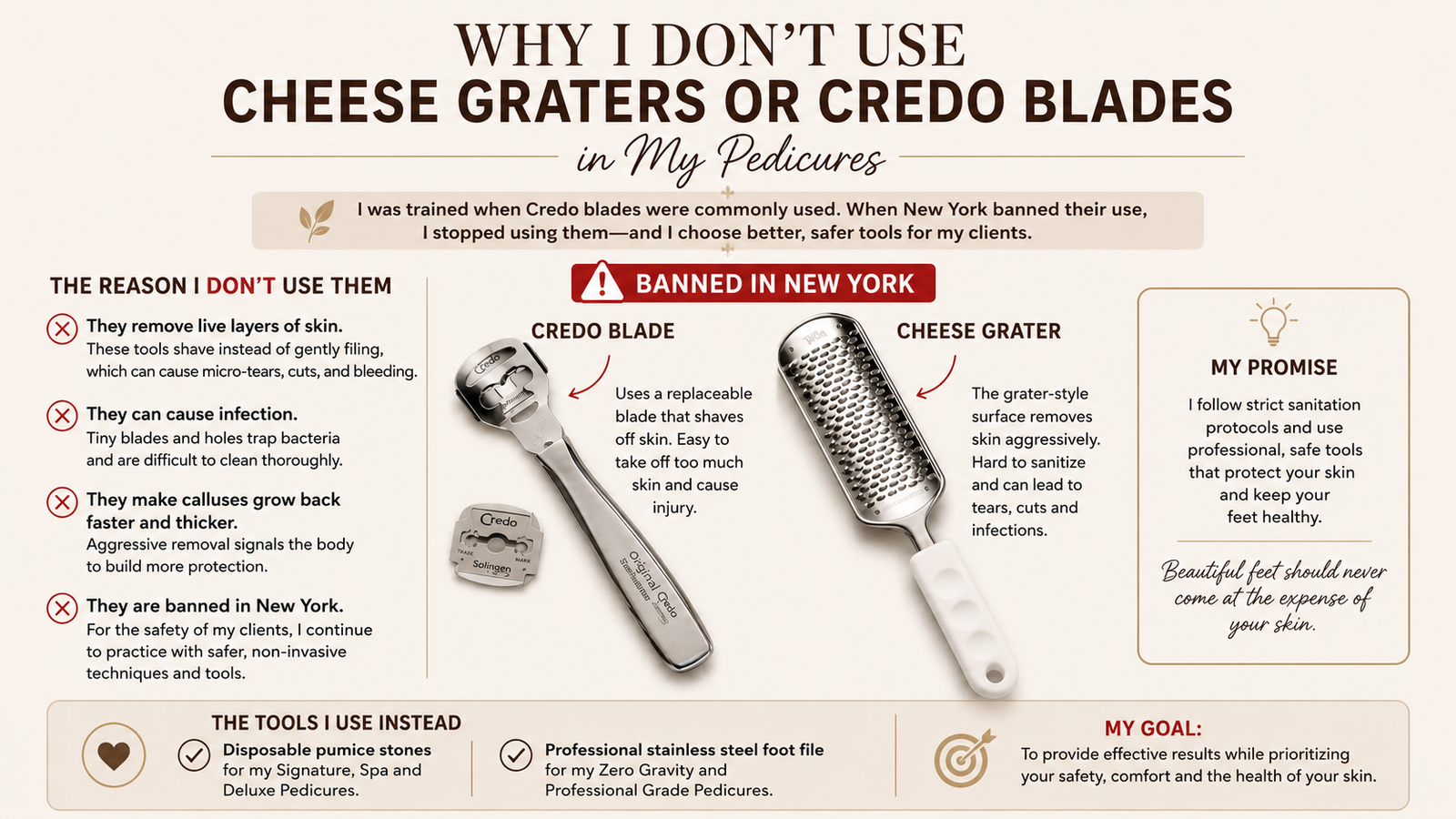
Let’s clear up something important: a Credo blade (also called a Credo knife) and a foot rasp (often called a “cheese grater”) are two completely different pedicure tools.
Early in my career in New York, I did use Credo blades for callus removal. At the time, they were commonly used in the industry. When New York banned Credo knives for appearance-enhancement services, I stopped using them—and I have never gone back.
A foot rasp or “cheese grater” is a different story.
I have never used a cheese-grater-style foot rasp on a client, nor would I attempt to use one in any of my pedicure services.
Why I Choose Other Methods
My goal isn't to aggressively scrape, shave or remove as much callused skin as possible. I have better and safer ways to reduce calluses and create that smooth, comfortable feeling my clients want.
For my Signature, Spa and Deluxe Pedicures, I use disposable pumice stones along with properly cleaned and disinfected professional stainless-steel implements when appropriate.
For my Zero Gravity and Professional Grade Pedicures, I prefer a professional stainless-steel foot file. It allows me to gradually reduce and smooth hardened skin while giving me greater control over the process.
A New Professional Standard: Dry Pedicures
I also offer Dry Pedicures, a modern approach to professional foot care performed without soaking the feet. This service is especially beneficial for clients who need more focused attention to ingrown or involuted toenails, thickened nails, calluses and other challenging foot-care concerns.
For clients living with diabetes, I take a conservative approach with an emphasis on sanitation, gentle techniques and protecting the integrity of the skin. Services are provided within my professional scope of practice, and clients with conditions requiring medical treatment are referred to an appropriate healthcare provider.
My goal is simple: provide thorough, professional foot care while keeping the health and comfort of your feet at the forefront.
More Isn't Always Better
Callused skin doesn't need to be aggressively removed in one appointment.
My approach is to reduce hardened skin safely and gradually while protecting the integrity of the surrounding skin. Sometimes severely dry or callused feet require ongoing professional care and good maintenance at home to achieve the best results.
After decades in this industry, I've learned that the most aggressive tool isn't necessarily the best tool.
I don't need a Credo knife or a “cheese grater” to give my clients beautifully smooth feet—and neither one has a place in my pedicure services today.
Beautiful feet should never come at the expense of healthy skin.
Want to See What I Use Instead?
Watch my video to see the professional stainless-steel foot file I prefer and why I use it for controlled callus reduction.
If you've ever had a professional pedicure, you may have seen a metal foot rasp that looks suspiciously like something you'd find in your kitchen—a cheese grater.
You may have also seen a Credo blade, sometimes called a callus shaver, which uses a small blade to shave hardened skin from the feet.
I've worked in the beauty industry for many years, and I've seen professional pedicure practices change considerably during my career.
I Actually Used Credo Blades Early in My Career
When I began my career in New York, Credo blades were used in the industry, and I used them as part of pedicure services.
As regulations and professional practices changed, New York prohibited the use of Credo knives in appearance-enhancement services. I stopped using them and moved away from aggressive “cheese grater” style callus-removal tools as well.
After so many years of working without them, I simply don't feel that I need them to provide an effective pedicure.
But Aren't Pedicure Blades Illegal in Florida?
This is where things get interesting.
You may have heard that Credo blades and similar pedicure tools are illegal in Florida. I believed that as well.
However, when I researched the Florida Department of Business and Professional Regulation's current guidance, I discovered that Florida does not specifically prohibit particular tools.
Florida DBPR addresses the Credo blade directly and states that Florida law does not prohibit the use of certain tools; however, the procedures performed must be nonintrusive.
That's an important distinction.
The fact that a particular tool isn't specifically prohibited doesn't necessarily mean that every way of using that tool falls within a nail professional's scope of practice.
So Why Don't I Use Them?
My answer is simple:
I don't need to.
My goal isn't to remove every bit of hardened skin from someone's feet during a single appointment.
Calluses develop in areas exposed to repeated friction and pressure. Removing too much protective skin can leave the feet tender and vulnerable.
I prefer controlled, gradual reduction of hardened skin while maintaining the integrity of the surrounding skin.
What I Use Instead
The tools I choose depend on the pedicure service I'm performing.
For my Signature, Spa and Deluxe Pedicures, I use disposable pumice stones along with properly cleaned and disinfected professional stainless-steel implements as appropriate for the service.
For my Zero Gravity Pedicure and Professional Grade Pedicure, I prefer using a professional stainless-steel foot file.
I like stainless steel because it gives me control over the amount of hardened skin I'm reducing and, unlike porous or difficult-to-clean surfaces, a properly designed stainless-steel implement can be thoroughly cleaned and disinfected between clients according to professional sanitation procedures.
My goal is to reduce and smooth hardened skin—not aggressively shave the foot.
More Callus Removal Doesn't Mean a Better Pedicure
Sometimes people judge a pedicure by how incredibly smooth their feet feel immediately afterward.
But more isn't necessarily better.
A professional should evaluate the condition of the feet and determine how much hardened skin can appropriately be reduced during that service.
Some feet require ongoing maintenance rather than aggressive removal in one appointment.
This is particularly important to me because my pedicure services aren't one-size-fits-all. Different feet require different approaches.
Why I Prefer a Stainless-Steel Foot File
I've creating a video for my YouTube channel where I'll show you the type of stainless-steel foot file I prefer and explain why I choose it over more aggressive callus-removal tools.
I'll also talk about proper foot-file use and why I believe control, sanitation and technique matter just as much as the tool itself.
Watch the video:
Credo Blades & “Cheese Graters”: Why I Don’t Use Them
If you'd like the stainless-steel foot file I recommend for maintaining your feet between professional pedicures, it is also available through my website.
Shop the Stainless-Steel Foot File:
Stainless Steel Foot File
The Bottom Line
I've been in this industry long enough to remember when Credo blades were routinely used during pedicures. I've used them myself.
But experience also teaches you that just because you've always done something a certain way doesn't mean you have to continue doing it.
Today, I have tools and techniques that allow me to achieve the results I want without aggressively shaving the skin.
So, would I use a Credo blade simply because Florida doesn't specifically prohibit the tool?
No.
I've found an approach that works better for the way I practice today—and I'm perfectly happy leaving the cheese graters in the kitchen where they belong. 😉

No Comments Yet
Be the first to leave a comment.